Galvanic Isolator: not!

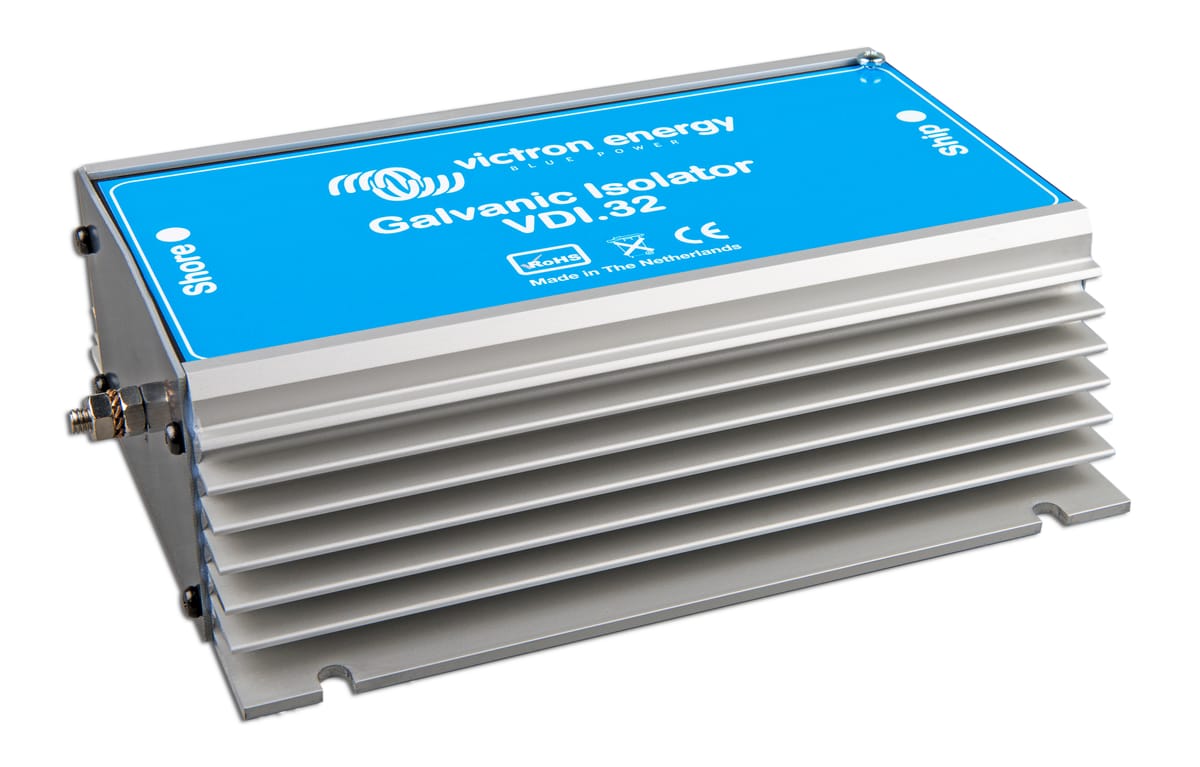
I previously called these gadgets a scam or at least a barely allowed trick and I did receive some feedback on that, asking if a company like Victron really is selling a scam product so let me put this into context with this post:
I call these gadgets scams or tricks because even though they are called galvanic isolators (GI), they don’t actually provide galvanic isolation! It’s simply not true, it doesn’t. So this isn’t linked to any specific brand, it’s the whole idea that is false.
I also found out that people think “electrocution” means “execution by electric chair”, i.e. death. For me this isn’t correct: it includes accidental electric shocks that may or may not kill you.
Galvanic isolation exists when energy or signals can cross only through an insulating barrier, with no direct electrically conductive path across that barrier. Examples of such barriers are air gaps where a signal or power is passed through the barrier as a beam of light/laser or a magnetic field. A diode is a semiconductor and does not represent such an insulating barrier.
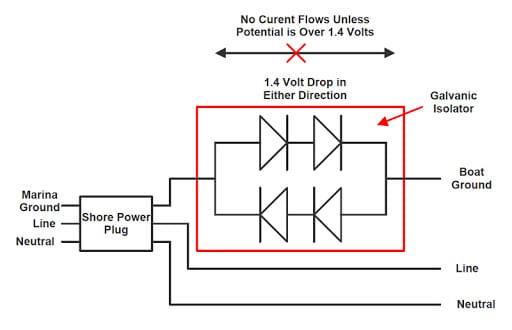
The diagram above shows what is inside: the line and neutral conductors pass around it, nothing is done with them. This means that the neutral is still grounded ashore, so when you touch line while also touching something grounded… like a wet floor… you still get electric shock just like without the galvanic isolator.
The ground conductor is where the trickery is done. As you can see, they put some diodes in an anti-parallel configuration. A diode needs a 0.7V offset to start conducting so they connect two in series to increase that to 1.4V.
For how these diodes prevent galvanic corrosion, a very simplified explanation: galvanic corrosion is the result of DC current. This DC current is the result from your underwater metals like prop, shaft, zinc anodes etc. being submerged in water, forming part of a battery with the other half formed by shore side ground. Hopefully, the voltage of this “battery” is below 1.4V so that the diodes don’t start conducting, which is the protection provided.
So what the GI protects against is galvanic corrosion when the DC voltage is below 1.4V. It does NOT protect against stray current which is at much higher (start or house battery) voltage and it provides no safety against electrocution at all.
But it’s worse than that… much worse. Besides DC voltage caused by underwater metals, we also have AC voltage due to leakage and the two are superimposed. So if your DC voltage on a boat with grounded AC is 1.1V, which is common, and you have an AC ripple of only 0.5V, then at every positive cycle of the AC, the 1.6V sum causes the diodes to conduct and you have partial galvanic corrosion.
Now we have a closer look at possible faults: if diodes burn out, for example by a nearby lightning strike, then you have lost ground protection and thus you run much higher risk of electrocution. But at least you don’t have galvanic corrosion anymore ;-)
But a diode can also fail as a short. Now your underwater metals are eaten away while you falsely think you have an isolator. But at least you run less risk of electrocution!
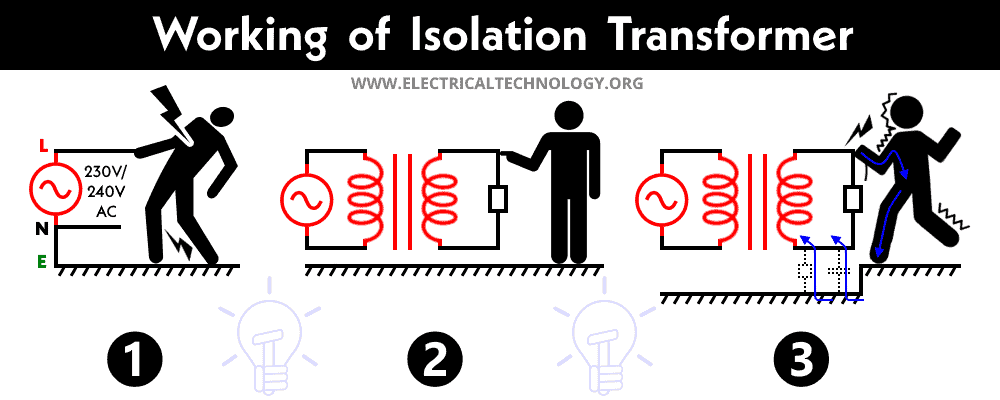
So let us look at the isolation transformer again. the #1 picture above shows how you can be electrocuted without it: ground provides a return path to neutral because it is connected to the neutral. In picture #2 we are safe because the secondary winding is not connected to ground, regardless of the configuration at the primary winding. Picture 3 shows that we can still get into danger when somehow, somewhere a connection to ground appears. We call that an isolation fault and this can be salt/moisture buildup or a fault inside an appliance. This reduces our safety, much like normal AC power again, except we have a Line Isolation Monitor that detects this and warns us so that we can find and clear the fault.